Every crew member on a commercially operated yacht must get at least 10 hours of rest in any 24 hours and 77 hours in any 7 days, and the yacht must be able to prove it. That second part is where most yachts fall down.
On a superyacht in season, hours of rest are under constant pressure: late dinners, early departures, tender runs, guest requests at 2am. Flag states have noticed. The Cayman Islands registry has publicly called the yacht sector a notable outlier on rest compliance, and named insufficient rest as a factor in recent incidents on its own yachts (Cayman GN 03/2022).
This guide covers what the MLC and STCW actually require, how exceptions work, what records an inspector expects to see, and how management companies can keep a whole fleet compliant without chasing spreadsheets.
The rules in one table
Two conventions set the limits: the ILO's Maritime Labour Convention 2006 (MLC, Standard A2.3) and the IMO's STCW Convention (Section A-VIII/1 of the Code). On the core numbers they agree.
| Rule | Limit |
|---|---|
| Minimum rest in any 24 hours | 10 hours |
| Minimum rest in any 7 days | 77 hours |
| Maximum number of rest periods per 24 hours | 2, one of them at least 6 hours long |
| Maximum gap between two rest periods | 14 hours |
| Alternative MLC limit (if the flag uses hours of work) | 14 hours work in 24, 72 hours work in 7 days |
Two details trip people up. First, the limits are rolling: "any 24 hours" means any window, not midnight to midnight, so a late night followed by an early start can breach the rule even if each calendar day looks fine. Second, rest means time completely off duty; short breaks during work don't count.
Your flag state can set stricter rules, so always check its marine notices. The Bahamas Maritime Authority's Marine Notice 35 is a clear example of how a flag writes these limits into its own requirements.
Who it applies to on a yacht
The MLC covers everyone working on board a ship ordinarily engaged in commercial activity, so on a charter yacht that means the whole crew: deck, engineering, interior and galley. A stewardess turning down cabins at midnight is as covered as the officer of the watch.
STCW adds its own rest requirement for watchkeepers and anyone with designated safety, security or pollution-prevention duties. On most yachts that overlaps heavily with the MLC group anyway.
Privately used yachts may fall outside the MLC depending on the flag and how the vessel is operated. Even then, many flags, insurers and management companies apply the same limits as good practice, and fatigue is a safety risk regardless of the yacht's legal status.
Crew under 18 have stricter limits: generally no more than 8 hours of work a day and 40 a week, with mandatory breaks.
Exceptions: what's allowed and what isn't
Exceptions exist, but they are narrow, and guest service is not one of them.
Emergencies. The master can suspend scheduled rest when the safety of the vessel or people on board is at immediate risk, or to assist others in distress. Affected crew must get compensatory rest once things are back to normal, and the reason, the people involved and the duration go in the official log.
Drills and call-outs. Musters and drills should be planned to disturb rest as little as possible. Crew who are on call and get woken up should receive compensatory rest for the time lost.
STCW exceptions for watchkeepers. Some flags allow limited exceptions for watchkeepers and safety-duty crew. Under the Bahamas notice, for example:
- the daily 10 hours may be split into up to three periods (one at least 6 hours, the others at least 1 hour), on no more than two days in any 7;
- the weekly minimum may drop to 70 hours, for no more than two consecutive weeks, with a recovery interval at least twice as long as the exception.
What is not an exception. Normal guest activity is a scheduling matter, not an emergency. The Cayman registry has warned specifically against abusing the "emergency call-out" route and over-relying on compensatory rest to cover routine service (GN 03/2022). If a yacht needs exceptions regularly, the problem is manning or scheduling, and flags expect the company to reassess it.
The records an inspector will ask for
Compliance has to be provable. During a flag survey, port state inspection or ISM audit, expect to be asked for four things:
1. A table of shipboard working arrangements. A schedule for every position showing duties at sea and in port, and the minimum rest (or maximum work) that applies. It must be in English and the working language of the yacht, and accessible to the crew.
2. Individual rest records for every crew member. Usually in the IMO/ILO model format, hour by hour.
3. Signatures. Each record is typically completed monthly and endorsed by both the master (or someone the master authorises) and the crew member.
4. A copy for the crew member. Every seafarer is entitled to a copy of their own record.
Electronic records are accepted by many flags, provided the system can show compliance and any change is time-stamped and visible (Bahamas MN 35). That audit trail matters: a record that can be quietly edited is not much of a record.
Inspectors also cross-check. Rest records that say a deckhand was asleep while the deck log shows a tender run at that hour are a red flag, and so are records that look identical week after week.
Six mistakes we see on yachts
- Filling in records at the end of the month. Records reconstructed from memory are inaccurate and easy to spot. Log rest daily.
- Checking calendar days instead of rolling windows. A crew member can meet 10 hours on Monday and 10 on Tuesday and still breach the rule across the night in between.
- Treating guest requests as emergencies. A late beach dinner is not a safety event. Routine service has to fit inside the schedule.
- Copy-paste records. Identical hours every day of a charter week don't match reality, and auditors know it.
- Recording breaches but doing nothing about them. A logged violation with no follow-up looks worse than the violation itself. Treat repeat breaches as ISM non-conformities with a corrective action plan.
- Ignoring the interior and galley. Rest rules aren't just for the bridge. Interior and galley crew often carry the heaviest hours in season.
What management companies should do across a fleet
Flags put responsibility on the company and the owner as well as the master. When breaches are significant and regular, they expect owners and operators to get directly involved in fixing resourcing and schedules, not just the captain. For a management company, that means:
- Write a rest and manning policy into your SMS. Define how schedules are set, who approves deviations, and what triggers a review.
- Check manning against the real operating profile. Minimum safe manning covers safe operation, not a 24/7 guest offering. If a yacht can't deliver its charter programme within the rest limits, the crew size or the service level has to change.
- Monitor every vessel from shore, every week. Don't wait for the monthly signed sheets to find out a crew member has been short of rest for three weeks.
- Handle repeat breaches as non-conformities. Log them, agree a corrective action with the captain, and check it worked.
- Plan for the season before it starts. Shift patterns for busy periods, structured guest timetables and extra hands for the galley are all fixes flags have seen work.
The Cayman guidance includes real feedback from yachts that fixed their rest problems. Many of them moved from an "everything always available" operation to a more structured day, and found guests didn't object.
How Nauticare helps
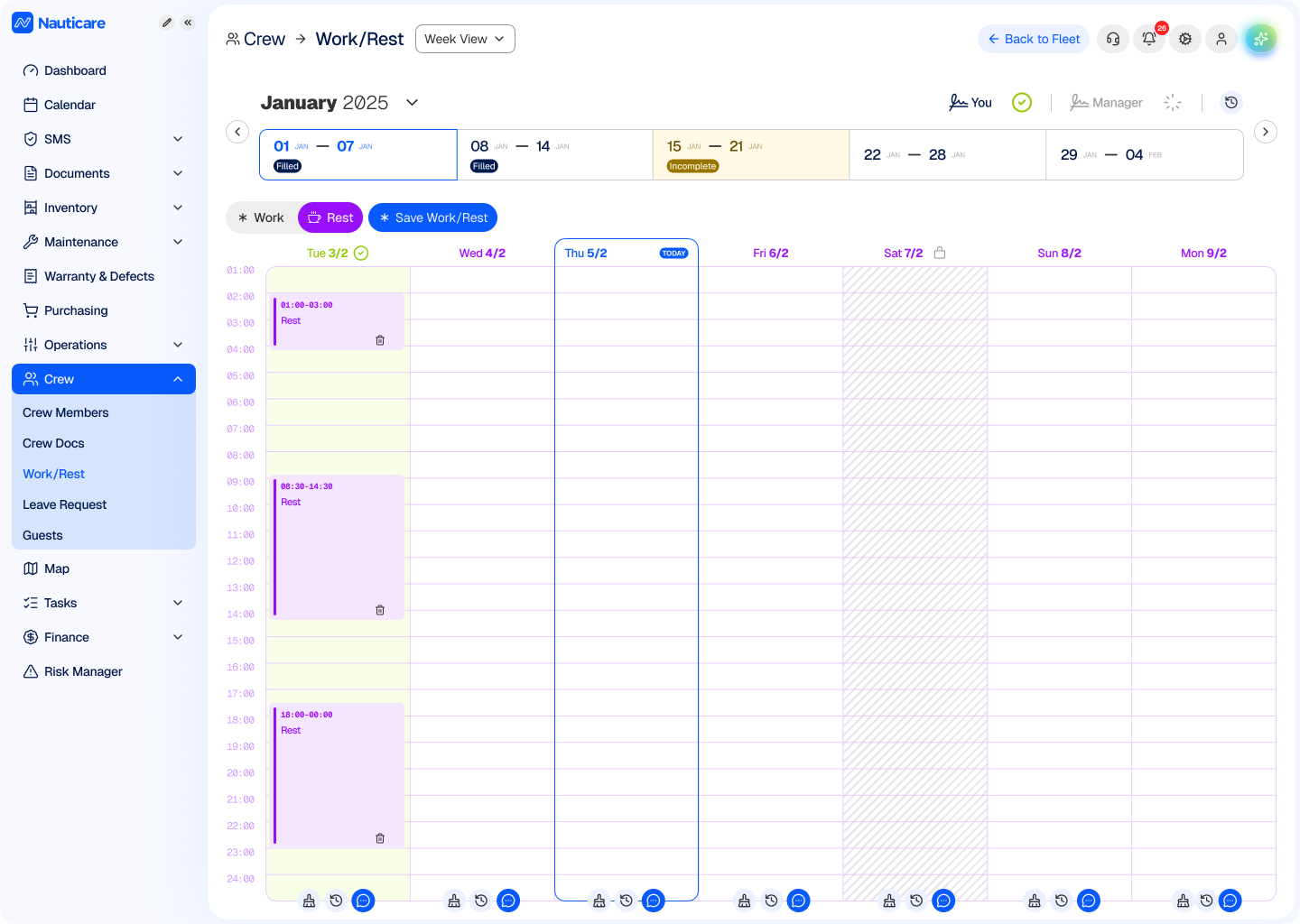
Nauticare's Crew module replaces the paper sheet and the spreadsheet with one record that crew, captain and office all work from:
- Crew log work and rest hours from their phone, on the day, onboard, even offline with Nauticare Local.
- Captains and managers see every crew member's hours at vessel and fleet level, without waiting for month-end paperwork.
- Export records for flag, port state or ISM audits in minutes.
- Record breaches as ISM forms with digital signatures and a full audit trail, so corrective actions are documented too.
- Crew documents and certificates live in the same place, with expiry alerts, so everything an inspector asks for is in one system.
Every new account comes with a demo yacht preloaded with sample data, so you can see the crew module working in a few minutes.
Try Nauticare free for 7 days, no credit card needed. Managing a fleet? Book a 30-minute call and we'll show you how it works across multiple vessels.
FAQ
What are the minimum hours of rest for yacht crew? At least 10 hours in any 24-hour period and 77 hours in any 7-day period, under both the MLC 2006 and STCW.
Can the 10 hours of rest be split? Into no more than two periods, one of which must be at least 6 hours. The gap between rest periods can't exceed 14 hours. Some flags allow a three-way split as a limited exception for watchkeepers.
Do drills count as rest? No. Drills should be scheduled to disturb rest as little as possible, and crew should get compensatory rest for time lost.
Can guest service justify an exception? No. Exceptions cover emergencies and safety, not routine service. Regular breaches mean the schedule or manning needs to change.
Are electronic hours of rest records accepted? Most flags accept them if the system shows compliance clearly and records every change with a time stamp. Check your flag's notices.
Who signs the records? Typically the master (or someone the master authorises) and the crew member, usually monthly. The crew member gets a copy.
Sources
- Maritime Authority of the Cayman Islands, Guidance Note 03/2022: Seafarer Rest and Fitness for Duty
- Bahamas Maritime Authority, Marine Notice 35: Hours of Rest
This article is general guidance, not legal advice. Always check the current requirements of your flag state.